
Thomas Paine
Our nation’s semiquincentennial year has kicked off with the 250th anniversary this week of the publication of “Common Sense” by Thomas Paine (1737-1809). He’s the English philosopher and revolutionary who came to America in late 1774 and published his famous work barely a year later. His best-selling manifesto for freedom was so persuasive and fiery the Second Continental Congress borrowed large chunks of its logic when fashioning the Declaration of Independence just a few months later on July 4, 1776.
I’ll leave it to the historians and the scholars to ponder the continuing significance of Paine and his literary output. Admittedly, there’s no Las Vegas hook for this, but I am sometimes known to ponder matters far and wide. So I’m going to take another look at New Rochelle, N.Y., a leafy New York City suburb where I have relatives and have frequently visited long before becoming New To Las Vegas. They live just a block from one of the strangest and most bogus shrines to political action in America that I know of–strange and bogus mainly because nothing political ever happened there.
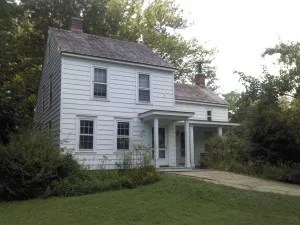
Thomas Paine Cottage Museum, New Rochelle, N.Y.
I am referring to what is now called the Thomas Paine Cottage Museum. The rather nondescript structure is perhaps the last tangible vestige of Paine. Why am I so down on this tribute to a man listed among the country’s Founding Fathers? Here are some reasons.
–Paine didn’t write “Common Sense” at his cottage-now-museum, which he did once own. He authored the work in Philadelphia, 100 miles to the south. Nor did he write at the cottage his other most-famous works, which included “The Age of Reason,” “Rights of Man” and “Agrarian Justice.”
–Because he also was fomenting the later revolution in France–where he almost lost his own head–Paine lived in the cottage for only four years, a residency that didn’t even start until more than a quarter-century after he wrote “Common Sense.” So the cottage was basically a retirement pad. And a part-time one at best. In his later years Paine also maintained a home in New York City’s Greenwich Village, which is where he died in 1809.
–The current location of the cottage has little historical accuracy. At the time Paine lived in it, the house, rebuilt after a fire, was located a quarter-mile away up a hill. It was rolled down Paine Avenue to its present location in 1908–99 years after Paine’s death–so real-estate developers could start developing the area including much of Paine’s old spread with stately homes that still exist.
–The “museum” contents of the cottage include precious few historical items with any real connection to Paine, including two chairs he sat in and a Franklin stove given to him by its inventor, Benjamin Franklin, who was also his patron. The holdings are largely period nick-knacks.
–A marker installed in 1952 accurately notes the spot along North Avenue where Paine was buried a few yards from where the cottage now stands. But what the marker’s inscription doesn’t say is that 10 years after Paine’s death, a crazy London journalist in 1819 secretly dug up his bones and shipped them back to England, where they were eventually lost to history. Nearly two centuries later, in 2009, the heist made a Time Magazine list of “Top 10 Famous Stolen Body Parts,” along with Geronimo’s skull and Napoleon’s, uh, junk.
–When I visited more than a decade ago, the two-story cottage itself was a little ratty, no doubt due to strained financial resources of its owner, the Huguenot & New Rochelle Historical Society (Huguenots were French Protestants who left France in the face of religious persecution; they founded New Rochelle in 1688.) The facility then was only open limited hours a few days a week. According to its website, it’s now only open for visitors on prior request.
The Paine Cottage Museum sits on the western edge of the roughly rectangular, 277-acre parcel that the New York Legislature gave Paine in 1784–nearly a decade after writing “Common Sense”–in recognition of his service to the Revolution. Given Paine’s fame as a exponent of individual freedom, the circumstances have to be regarded as a little questionable: The land and the cottage had been seized years earlier from one Frederick DeVeaux, a supporter of King George III.

Thomas Paine Memorial, New Rochelle, N.Y.
I find the real estate connection utterly underwhelming. But if you’re going to fake it, fake it with volume. There’s a nearby marble monument to Paine along North Avenue at the foot of Paine Avenue, very close to where he was buried and stolen, erected in 1839 and topped by a bronze bust added in 1905.
But there’s more. That same marketplace of ideas nurtured by Paine produced for the longest time in New Rochelle what I regard as a delicious irony: competing Paine nonprofits hurling invective at each other across Paine Avenue, in the fashion of the Great Man himself.
About 90 yards from the Cottage past the burial marker and the monument along North Avenue sits a grand building edifice called the Thomas Paine Memorial Building. Also a museum, it was built amid much fanfare in 1925 by the Thomas Paine National Historical Association (inventor Thomas A. Edison wielded the groundbreaking shovel). It held far more genuine Paine artifacts and was a respected resource for serious Paine scholars.

Thomas Paine Memorial Building, New Rochelle, N.Y.
For the longest time the two nonprofits long hated each other, routinely trading accusations. One year, the Huguenots with their cottage gave a “Spirit of Thomas Paine” award to Dick Morris, the Democrat-turned-Republican political operative and pundit. The Paine Memorial Building, which used to issue its own annual award, promptly cranked out a press release mocking its rival’s understanding of Paine’s political philosophy, which included encouragement of progressive taxation and disparagement of organized religion, not exactly mainstays of contemporary Republican thought. “The Huguenots should look after the history of the Huguenots,” the snarky statement said.
When I visited the cottage in 2013, its director, John R. Wright, accused the Paine Memorial Building of fundraising by trying to fool people into thinking it owned the cottage. “It is absolutely misrepresenting itself,” he told me.
But meanwhile the Paine Memorial Building was shut for more than a decade following scandalous allegations it sold off key holdings and cut too sweet a deal for its director. Under pressure from state charitable regulators, much of its remaining contents were transferred to the library at nearby Iona College.
Things eventually got back to normal after a change of management. The Paine Memorial Building is now open for tours on Saturday afternoons, Its parent last year announced a merger with a U.K. organization, Thomas Paine Society, to form the Thomas Paine Historical Association (dropping “National”). Meanwhile, it and the Cottage Museum no longer speak ill of each other in public.
For several decades there’s been a move afoot to establish a Paine monument in Washington D.C., where, at least, his revolutionary thoughts did come to fruition. Such an action probably wouldn’t much affect New Rochelle, a well-to-do burg of 80,000 fronting Long Island Sound, whose tourism pales compared with the more than 40 million who hit Vegas each year. New Rochelle is far better known as the setting for the 1960’s TV series “The Dick Van Dyke Show” and the literary world’s “Ragtime.” That’s the hit novel, film and Broadway musical franchise fashioned by one-time New Rochelle resident E.L. Doctorow. He was inspired by his own house, whose back yard, as it happened, touched the original location of the Paine Cottage.
The sitcom and the novel both were fiction–appropriately, not unlike Paine’s political connection with New Rochelle.
Great historical recap. Always interesting to read your blog. Hope all is well with you and yours.