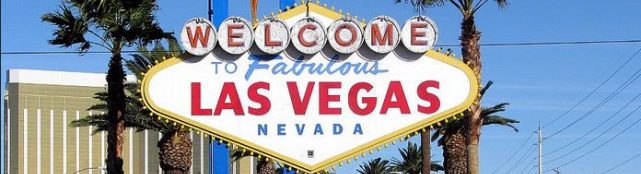
 Everyone knows about “Viva Las Vegas.” That was the hit 1964 movie pairing a sizzling Elvis Presley and Ann-Margret (in real life, too, if you believe the gossip) in a romantic tale of two race-car drivers chasing the same girl. The signature song of the same name remains something of a local national anthem. Despite filming much of the movie on location around Las Vegas (including in the gymnasium of what would become UNLV), the world premier actually was in New York City.
But eight years earlier–and exactly 60 years ago this weekend–the El Portal theater on Fremont St. rolled out the red carpet for the world premiere of another hit musical based and largely shot in Sin City. The flick was “Meet Me in Las Vegas,” featuring Cyd Charisse and Dan Dailey. They were big names in their time–Charisse in particular due to her legs (see nearly movie poster) and dancing ability, although now she’s somewhat faded in movie history beyond a distinctively alliterative stage name (she was born Tula Ellice Finklea). Still, the plot line in MMILV makes it in some ways a more quintessential feel-good period-piece movie about Vegas than Viva! or many of the other movies framed hereabouts. The 112-minute flick still can be seen on various streaming platforms.
The story line of the lavish MGM-produced movie goes something like this. Chuck Rodwell (played by Dailey) is a well-liked Nevada rancher living with his mother who comes into Las Vegas once a year to gamble at the old Sands Hotel and Casino (where much of the movie was shot on location). He’s not especially good at betting, but he superstitiously thinks that if he holds the hand of an unsuspecting woman, he will win.
A movie these days premised on such a maneuver might not fly, but this was the the mid-1950’s. As it turns out, that lady is Maria Corvier (played by Charisse), a fetching Russian ballerina from Paris storming out of the dinner theater during what would now be called a residency offended that patrons are eating and drinking during her show. Much to her dismay, he grabs her hand–then wins at roulette. She rebuffs his effort to tip her, but shake hands–and he wins at the slots. Maria warms up to Chuck–and he keeps winning. He puts a coin in a slot machine for a random stranger–Frank Sinatra, one of many un-credited cameo figures in the movie–and he wins, too.
The two prance around other Las Vegas casinos winning, figuring what works and what doesn’t in turns of hand-touching, and causing dismay among other casino operators, one of whom tries to break the lucky streak. After the usual miscommunications, advice from a buddy, and so on, Chuck finally figures out that Maria is sweet on him. He takes her to the ranch, apparently just an hour or two away, to meet her mom (played for considerable laughs by the venerable Agnes Moorehead, a distinguished actress later to be better known as the disapproving mother-in-law witch Endora in TV’s “Bewitched’).
While visiting, the ranch strikes oil (shades of the James Dean gusher scene in “Giant,” the very serious Texas family saga based on the Edna Ferber novel of the same name that also came out that year). Now this was one part of Isobel Lennart‘s original screenplay that was totally unreal, since there’s never been much oil production in Nevada. Anyway, Chuck and Maria take that as a promising omen and become engaged. That proves to be a good thing because when they return to Las Vegas, his luck goes cold. Of course, Maria is no longer an unsuspecting woman. But they still have that oil (and, I guess, some cattle). At the end they agree to split their time between the ranch and Sin City, with Chuck agreeing to give up gambling.
Throughout all of this are interspersed some interesting bits. Uncredited cameos besides Sinatra (who later had an ownership stake in the Sands through much of its Rat Pack heyday) include entertainers Debbie Reynolds, Vic Damone and, in a rare un-sinister moment, Peter Lorre.
Near the end there is a satirical ballet rendition (with Charisse dancing) of the old ballad “Frankie and Johnny,” but with bebop lyrics by Sammy Cahn. As Bosley Crowder gushed in his generally favorable New York Times review of the movie, the number “is sung by the off-screen voice of Sammy Davis Jr.. It’s crazy, man! And cool!” At another point the great Lena Horne belts out a number.
The movie earned one Oscar nomination, for its musical score by George Stoll and Johnny Green. They lost to Alfred Newman and Ken Darby for the Yul Brynner classic, “The King and I.”
MMILV was one giant advertisement for Las Vegas in general, and the Sands in particular. The opening title sequence consists of the popular singing quartet The Four Aces warbling about all the fun to be had in Las Vegas. This was followed by an somewhat superfluous opening card reading, “In the early days of our country’s history, the West was a place from which men took vast quantities of gold. Now-at last—they’re bringing it back.” Okay.
Built just four years earlier, the Sands already was well on its way to achieving iconic status in Las Vegas, due in no small part to the famous performers in its famous Copa Room, including the patronage of Sinatra et al. There is no hint in MMILV of its criminal ownership, utterly devoted to skimming winnings before they could be declared and taxes paid. This is how Ed Reid and Ovid Demaris put it a few years later in their seminal 1963 exposé, The Green Felt Jungle:
The Sands has been controlled by more different mobs than any other casino in Nevada. Licensed and “respectable” fronts represented the interest of gang leaders in Houston, Galveston, St. Louis, Los Angeles, San Francisco, Minneapolis, Chicago, Detroit, Cleveland, New York City, Newark, Jersey City, Brooklyn, Boston, Miami and New Orleans.
Howard Hughes eventually bought the Sands from the mob, and after several ownership changes, the guiding force became Sheldon Adelson. In 1996 the by-then down-and-out Sands was imploded, and the Venetian built in its place.
Here’s a little bit more about that big opening night on February 21, 1956. “Stars Gather in Vegas for Film Premiere,” the Las Vegas Review-Journal breathlessly reported. Among them besides the stars in the movie: Milton Berle, Groucho Marx, Walter Pigeon, John Barymore Jr., Hugh O”Brien, Peter Lawford, Fred MacMurray, Eddie Cantor and Jimmy Durante. Berle recorded his top-rated weekly NBC television variety show there at the Sands, making it, according to the flacks, the first nationally broadcast color TV show ever made in Las Vegas.
News pictures show crowds held back by ropes swarming around the 700-seat racially segregated El Portal theater for the 8:30 p.m. showing on a surprising (for Las Vegas) chilly night. Built in 1928 and located at 310 Fremont St., the theater with its elegant Spanish-motif lobby was Las Vegas’s first air-conditioned building and a center of cultural life. It ceased being a theater in 1978 and is now an arcade within the Fremont Street Experience.
MMILV was hardly the first world premiere staged in Las Vegas. In 1952, there was “The Las Vegas Story.” That was a lackluster film noir produced by Howard Hughes starring Jane Russell, Vincent Price and Victor Mature in a hard-to-follow tale of a disintegrating marriage, a murder, and gambling establishments with cheesy names like Last Chance Casino and Fabulous Hotel and Casino. It opened at the Fremont Theater, also on Fremont St.
The year 1955 saw the world premiere at the nearby Palace Theater of the “Las Vegas Shakedown.” This was a tale in which a teacher writing a book about the evils of gambling (Coleen Gray) meets an honest (in Las Vegas??!!) casino owner (Dennis O”Keefe) threatened by a gangster. Despite the promising title, the movie was criticized as having too many subplots not tied together by the end.
By contrast, “Meet Me in Las Vegas” is pretty much unified and care-free all the way through, helped along by music, dancing and a light, amusing plot that doesn’t exactly tax the mind. At the end, Chuck and Maria agree to split their time together between Las Vegas and his oil-soaked ranch out of town. So once again, as I long have argued as someone New To Las Vegas, what happens here in Vegas doesn’t always stay here.