Only in Nevada (even if not in Las Vegas)

From Nevada Governor Steve Sisolak’s coronavirus order that nonessential businesses in the state must close for 30 days (emphasis added at the New To Las Vegas world headquarters):Only in Nevada In case you wonder, prostitution is legal in much of Nevada, although not in Clark County, where Las Vegas is; Washoe County, home of Reno; or Carson City, the capital, which is an independent city.

In 2018, voters in Nye County, immediately to the west of Clark County where prostitution is legal, elected Republican Dennis Hof to the State Assembly in a landslide. This was noteworthy for two reasons: (1) Hof, a TV personality who wrote an autobiography entitled The Art of the Pimp, was the owner of seven brothels in Nevada, which he said would be good experience for working with other lawmakers, and (2) he had died three weeks before the election, found deceased in his bed the morning after his 72d birthday party.

Nothing says Nevada quite like a dead pimp elected to the Legislature.

Follow William P. Barrett’s work on Twitter by clicking here.

Social distancing Las Vegas-style

Social distancing Las Vegas-style

Las Vegas signage

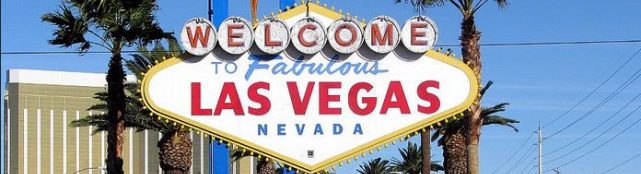
A mandatory stop for many tourists to Las Vegas is the famous “Welcome to Fabulous Las Vegas” sign. Since 1959, it has sat in the median at the southern tip of the Las Vegas Strip next to the airport. In a normal 24-hour period, thousands of tourists line up at all hours of the day and night to have their photos taken in front of the icon, a free background offering absolute proof of a Vegas visit. Since becoming New to Las Vegas, I often have taken visiting guests over for a keepsake shot.

Of course, thanks to the coronavirus crisis, these are not normal times. Vegas is essentially shut down and likely will remain that way well into April at a minimum. With all casinos and many hotels with their fancy shows closed, tourism is down to a trickle.

This afternoon, I drove the 2½ miles between Flamingo Road and the sign, a stretch through the heart of the Strip that passes the famous Bellagio Fountains where folks like to gawk. Normally, there would be maybe 10,000 people on foot along both sides of the famous road.

Today, I counted exactly 49.

But not every tourist has disappeared, just 99.99% of them. So Clark County, which maintains the area around the Vegas sign (which is more than four miles outside the city limits of Las Vegas proper), has posted a small sign. It asks tourists to observe social distancing guidelines and stay six feet apart.

When I passed by today, there were tourists at the sign. As you can see by my nearby photo, the social distancing guidance was ignored.

Follow William P. Barrett’s work on Twitter by clicking here.

Coronavirus crisis suggests Las Vegas economy remains a one-trick pony

Las Vegas economyEver since becoming New To Las Vegas in 2016, I’ve heard plenty of local claims the Las Vegas area is successfully diversifying its economy away from reliance on the sin stuff that long made the Strip famous (or infamous): gambling, entertainment and lodging. Building a knowledge-based, tech-driven economy for the 21st Century, local leaders proclaimed. It’s no longer like 2008, they said, when the Great Recession abruptly dried up tourism and all the sectors associated with it. The Las Vegas Valley was one of the country’s hardest-hit area, and recovery took a long time.

But to my mind, the coronavirus pandemic already is giving the lie to those economic diversification claims hereabouts.

The Las Vegas Valley is reeling and had been even before Gov. Steve Sisolak last night ordered a minimum 30-day statewide closure of all casinos, restaurants, bars and other non-essential businesses. World-famous Las Vegas Strip resorts–Encore, Wynn, Cosmopolitan, Venetian, Palazzo, all eight MGM properties–were already shutting down their operations. Famous entertainment acts–Cirque du Soleil, David Copperfield, Penn & Teller–went dark. Cascading layoffs are accelerating, although many of the casinos say they will keep workers on the payroll for varying lengths of time or at least cover health care premiums.

The Las Vegas Review-Journal announced it was suspending a number of sections, including its weekly entertainment guide. “With Vegas headliners going dark, resorts suspending operations, movie theaters closing, concerts canceling and social events being discouraged, there is not much left in this city to advertise or list,”  the paper wrote.

For days the Strip has looked like more of a ghost town than video I’ve seen of other famous tourist venues around the country like Times Square in New York, a city that has a lot of other industries. Leaders like Las Vegas Mayor Carolyn Goodman are blaming the distress on media publicity about coronavirus rather than the resulting illness itself. Her comments by themselves–she pushed strongly for casinos to stay open–might be evidence of non-diversification.

Continue reading

Far from Las Vegas, coronavirus and Thomas Paine legacy in New Rochelle

coronavirus and Thomas Paine

Thomas Paine Cottage Museum, New Rochelle, N.Y.

New Rochelle, N.Y., a leafy New York City suburb where I have relatives, is in the news as a U.S. hotspot for cornoavirus. The New York State National Guard today started enforcing a one-mile-in-radius “containment zone” around a synagogue on North Avenue where a member came down with the illness that then infected any number of contacts. Residents can come and go as they like, although large gatherings are prohibited.

As it happens, within that zone a few blocks down North Avenue sits one of the strangest and most bogus shrines to political action in America that I know of–strange and bogus mainly because nothing political ever happened there. Before becoming New To Las Vegas, I wrote about this for another blog in 2013, from which this account is drawn. Cornoavirus gives me a fresh hook to resurrect the curious tale.

I am referring to what is now called the Thomas Paine Cottage Museum. The structure is perhaps the last tangible vestige of Paine (1737-1809), the English philosopher and revolutionary who came to America in late 1774 and within 14 months published “Common Sense.” That was the best-selling manifesto for freedom so persuasive and fiery the Second Continental Congress borrowed large chunks of its logic when fashioning the Declaration of Independence just a few months later.

Why am I so down on this tribute to a man listed among the country’s Founding Fathers? Keep reading to see some reasons. Continue reading